Saturday, July 10, 2010

Interface 16x2 LCD to a PIC microcontroller using C

Liquid crystal displays (LCDs) are more convenient ways of displaying output results in any microcontroller based projects. If you are new to microcontroller interfacing, and want to learn how to interface a LCD to a PIC microcontroller you need to look at this. Here you will find PIC16F628A interfacing with a 16x2 LCD display and the programming is done in mikroC.

The objective of this experiment is to interface a 16x2 LCD to PIC16F628A in 4-bit mode. This means the data transfer will use only four pins of the microcontroller. There is no additional hardware setup needed for this experiment, as we have a ready-made LCD interface female ......
Click here for more details.

PIC12F683 Development Board

If you have never tried PIC microcontrollers, you can start with Microchip's 8-pin PICs. One of the most versatile type is PIC12F683. It is a 8-pin Flash based, 8bit RISC microcontroller from Microchip. This little PIC microcontroller offers up to 6 I/O pins (the remaining two are power supply pins). It needs no external oscillator, as it has an in-built oscillator with software selectable frequency from 8 MHz to 125 KHz. It also offers a feature that allows external signals to wake it upfrom the sleep state.

If you want to explore the feature of this microcontroller, here is a set of complete circuit diagrams and test projects. Visit this for more details.

Thursday, April 8, 2010

Digital Clock/Date/Thermometer with PIC16F628/PIC16F84A and DS18S20/DS18B20

Here is a small adjustable clock/date with thermometer function based on PIC16F628 or PIC16F84 microchip and DS18S20 or DS18B20 temperature sensor. The hardware part is very simple because it only uses pic microcontroller, the DS18S20/DS18B20 sensor, 4x7 segments (common anode, something like KW4-301xxx Series), four 2N3906 transistors, some resistors.

Wednesday, April 7, 2010

PIC16F84A Tutorial Board

Source: http://www.electronics-lab.com/projects/mcu/001/index.html
The PIC16C84 was introduced in 1993 by Microchip and the first PIC microcontroller to feature a serial programming algorithm and EEPROM memory, both of which lend themselves to hobby use: only a simple and cheap programmer is required to program, erase and reprogram the chip. PIC16F84 is a flash version of PIC16C84.

Since then Microchip has released much advanced PIC microcontrollers but this is still very popular among hobbyists. One reason for this is that there are lots of resources available on it and some good books published on PIC16F84. If you are looking to learn PIC microcontrollers, this could be a good choice. You can make your own tutorial board and do experiments.
For details, visit this.

Tuesday, April 6, 2010

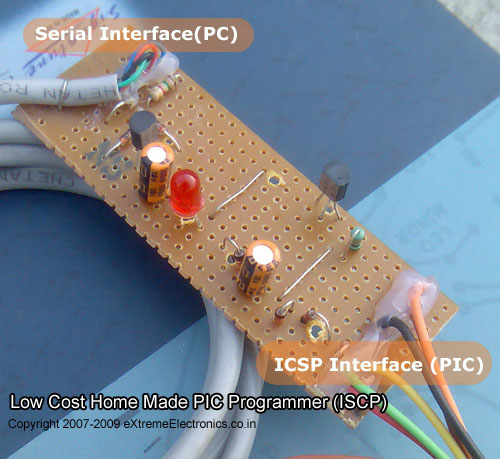
Make Your Own Serial PIC Programmer

If you are looking to make a PIC programmer by yourself, try this. This is a serial programmer (it may not work with USB to Serial converters) that uses two general purpose transistors and few resistors, diodes and capacitors. It is actually JDM based PIC programmer.
Source: http://extremeelectronics.co.in

For detail circuit diagram and description, visit this.