
Saturday, February 5, 2011
Heart rate measurement from fingertip
This projects describes an optical method to measure heart rate through fingertip. The volume of blood inside the finger artery varies with heartbeat. When an infrared light is passed through the fingertip, the amount of light absorbed is directly related to the blood volume. A photodiode senses this change in absorption and the signal is amplified further with a two stage filter/amplifier. The microcontroller reads the output from the amplifier and display the heart rate on a 3-digit seven segment LEDs.


Wednesday, January 5, 2011
Lessons for first time Propeller Programmers
If you are looking for beginner's lessons on Propeller microcontroller, these tutorials will be very helpful.


| Read |
Digital timer relay switch
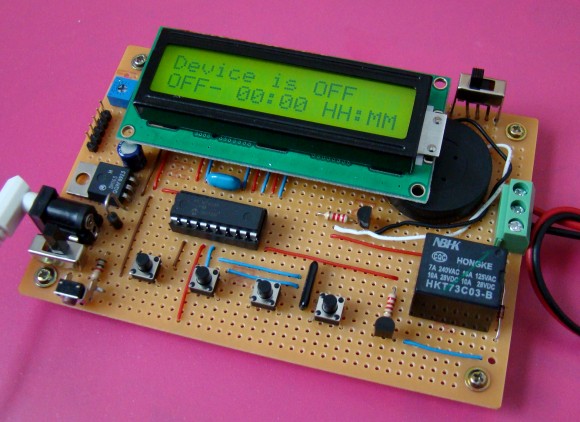
A programmable digital timer switch based on a PIC16F628A microcontroller. You can set both on and off time using push button switches. The program menu, and time information is displayed on a LCD screen.

| Read |
Thursday, September 30, 2010
Digital Temperature Meter using PIC16F688
A digital temperature meter based on PIC16F688 microchip and DS1820 temperature sensor that displays temperature on Celsius and Fahrenheit scales.
 Very cool project, firmware written in mikroC compiler.
| Read |
40x7 Running Message Display using PIC Microcontroller

| Read |
Monday, September 27, 2010
Serial LCD Driver using 74HC595 Shift Register
HD44780 based character LCD displays are very popular among hobbyists. They are easy to interface with microcontrollers and most of the present day high-level compilers have in-built routines for them. However, the bad part is at least 6 I/O pins of microcontroller are required to use them in your project. Therefore, they are not applicable for 8-pin devices like PIC12F series microchips. The aim of this project is to allow LCD interfacing to such devices using 3-wires. I am going to demonstrate this with PIC12F683 microcontroller. The character data or command from the microcontroller will be transferred serially to an 8-bit serial-in parallel-out shift register (74HC595), and the parallel output will be fed to the LCD driver pins.

Saturday, September 25, 2010
Frequency Counter Using PIC12F683
The Timer1 module inside PIC12F683 is a 16-bit timer/counter. If used as an asynchronous counter, this module can be used for counting the frequency of an external clock source applied to its GP5/T1CKI port. The following example is a 0-65535 Hz frequency counter using Timer1 module of PIC12F683. The Timer1 module is reset first and then turned ON for 1 sec to count the clock pulses arrived at its T1CKI port during that period. The number of pulses arrived in second is frequency itself. The measured frequency value is sent to PC through serial port and displayed on a hyperterminal receiver window. If the external clock frequency is over 65535 Hz, Timer1 overflows and an interrupt is generated. In case of the overflow, "Frequency out of range " message is displayed on the window. A 555 Timer IC running as an astable multivibrator is used as the external clock source.

Monday, September 20, 2010
Gas Sensor Using PIC16F84A
Here's a gas sensor circuit based on PIC16F84A and GH-312 sensor. GH-312 is able to sense gases like smoke, liquefied gas, butane and propane, Methane, alcohol, hydrogen, etc. Once it senses any of these gases, it triggers the microcontroller, which in turn switches on a buzzer and flash a LED.


Monday, September 13, 2010
PIC16F628A Mains Frequency Counter
This project reads the AC line frequency and displays on a LCD. The 120V AC is first converted to 12V AC using a step-down transformer. With the help of a BJT, the output Sine wave is further converted to 5V square pulses which is fed to TOCKI pin of PIC16F628A. The Timer0 module is used as an 8-bit counter. The counter counts the number of pulses arrived at TOCKI port in 1 sec, which, in fact, is frequency of manis AC, and displays it on a LCD.

Read rest of the project.

Read rest of the project.
Monday, September 6, 2010
Capacitance Meter: PIC16F88 + mikroC
If you don't have a capacitance measurement on your multimeter, here's one that you can make by yourself. This capacitance meter is based on capacitor charging time. PIC16F88 is used to measure the voltage rise across the capacitor and finds the time required to get the known voltage across it. Then it does some math and finds the capacitance value.


Source: http://www.pic_examples.byethost3.com/capacitance_meter.html
The firmware is written in mikroC. Read rest of the project.
Friday, September 3, 2010
Serial ISP Programmer for ATMEL AT89SXX
What is the first thing that you need when you first step in to the world of microcontrollers? Yes, it is a programmer. ATMEL's AT89S series microcontrollers are popular among hobbyists and designers. This projects describes about a simple serial programmer for AT89SXX microcontrollers.

The programming software that is available for free provides the following features:
# Device Supported - AT89S51, AT89S52, AT89S8252, AT89S8253.
# Read and write Intel Hex files.
# Chip Erase.
# Verify.
# Lock.
# Read Device Signature.
# Advanced Device Specific Functions.

Source: http://www.8052.com/users/AT89S52InSystemProg/
The programming software that is available for free provides the following features:
# Device Supported - AT89S51, AT89S52, AT89S8252, AT89S8253.
# Read and write Intel Hex files.
# Chip Erase.
# Verify.
# Lock.
# Read Device Signature.
# Advanced Device Specific Functions.
Wednesday, September 1, 2010
PIC Microchip Data Logger
This projects uses a single chip, PIC12F683 microcontroller, for temperature logging. A DS1820 sensor sends temperature value in digital format to PIC12F683 and it stores the value in to its internal EEPROM. The sampling interval for log can be selected from 1 sec, 1min, and 10 min using three tact switches.

The recorded temperature measurements can be downloaded to a PC through a serial interface. Read rest of the project.

The recorded temperature measurements can be downloaded to a PC through a serial interface. Read rest of the project.
Tuesday, August 31, 2010
Talking Clock
This is a very cool project. This digital clock speaks time in your voice. You have to first store audio samples in a SD card and the time is tracked by DS1307 RTC chip. The microcontroller used is Parallex Propeller running at 80MHz.
Popcorn Walkthrough from Gadget Gangster on Vimeo.

For functional details and others, visit link.
Popcorn Walkthrough from Gadget Gangster on Vimeo.

For functional details and others, visit link.
LCD Clock based on ATtiny2313
This LCD clock is based on ATtiny2313 microcontroller and displays time in 24 hour HH:MM:SS format. The accuracy is about +1 sec in 48 hours, and provides three tact switches for time setting.


For schematic and software, Visit Here.
Monday, August 30, 2010
Three Channel IR Remote Control based on PIC Microchip
This project is a 3-channel IR remote control for relays. It uses RC5 IR protocols.
Features :
* CPU PIC12F629 at 4MHz crystal for Tx/Rx
* 3 channel output relay
* The Tx use sleep mode for saving battery power
* Use Phillips RC5 protocal
* distance more than 7 m.
* Easy circuit to build and assembly

Features :
* CPU PIC12F629 at 4MHz crystal for Tx/Rx
* 3 channel output relay
* The Tx use sleep mode for saving battery power
* Use Phillips RC5 protocal
* distance more than 7 m.
* Easy circuit to build and assembly

Source: http://www.sixca.com/eng/articles/remote/index.html
On both the sides (Tx and Rx), it uses PIC12F629 microchips. For firmware and receiver part, visit here.
Sunday, August 29, 2010
Control Your Home Appliances using a DVD Remote Control
Are you looking for a device that can be used to control various household appliances (like fan, rice cooker, lights, etc) using your TV or DVD remote control? If yes, this is the project you are looking for. This is based on Atmega8 microcontroller. The microcontroller gets control commands from a DVD remote through IR link. Each time an appliance is turned ON/OFF, its status is stored in the internal EEPROM location so that it can be accessed later in case of power failure.

The firmware is written in AVR GCC. Read the full project.

Source : http://arif-ece.blogspot.com/2010/07/remote-controlled-home-appliances_10.html
The firmware is written in AVR GCC. Read the full project.
Saturday, August 28, 2010
PIC Based Temperature Data Logger
Here's a PIC based temperature data logger. The PIC used is 8-pin PIC12F683 and the temperature sensor used is DS1820 that doesn't require calibration and provides temperature value in digital format. This temperature logger records data inside the internal EEPROM. Each temperature value is 8 byte, so the resolution is 1 degree C.
Besides, the sampling interval is user selectable (1 sec, 1 min, or 10 min). The recorded values can be sent to a PC through a serial port.
Besides, the sampling interval is user selectable (1 sec, 1 min, or 10 min). The recorded values can be sent to a PC through a serial port.
Thursday, August 5, 2010
AT89C52 Based Contact-less Tachometer
Tachometer is a device that counts the revolutions per minute (RPM) of a rotating shaft. This projects describes how to make one that requires no contact with the rotating shaft. The microcontroller used is AT89C51 from Atmel, and the RPM value is displayed on a character LCD.

An IR Tx/Rx pair is used as a proximity sensor. The counted pluses will come from the proximity sensor, when it will detect any reflective element passing infront of it, and thus, will give an output pulse for each and every rotation of the shaft, as show in the picture below.

For circuit diagram and programming, read rest of the project.

An IR Tx/Rx pair is used as a proximity sensor. The counted pluses will come from the proximity sensor, when it will detect any reflective element passing infront of it, and thus, will give an output pulse for each and every rotation of the shaft, as show in the picture below.

For circuit diagram and programming, read rest of the project.
Wednesday, August 4, 2010
PIC-based Beginner’s Robot Autonomous Mobile (BRAM)
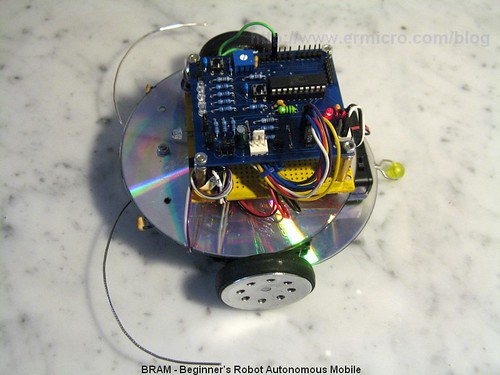
This tutorial shows how to build a Beginner’s Robot Autonomous Mobile, BRAM. It is designed to be easily built using some of the parts that you could easily found at home. The main controller for this robot is Microchip PIC16F690.

Two old CDs are used to build the chasis for the robot. The lower deck is use to hold the geared DC motor, battery power, caster and the robot’s bumper switches (whiskers) while the upper deck hold the robot’s motor driver, sensor’s board and the PIC16F690 circuit board.

The following are the list of BRAM’s construction material parts:
Source: http://www.ermicro.com/blog/?p=983
Two old CDs are used to build the chasis for the robot. The lower deck is use to hold the geared DC motor, battery power, caster and the robot’s bumper switches (whiskers) while the upper deck hold the robot’s motor driver, sensor’s board and the PIC16F690 circuit board.
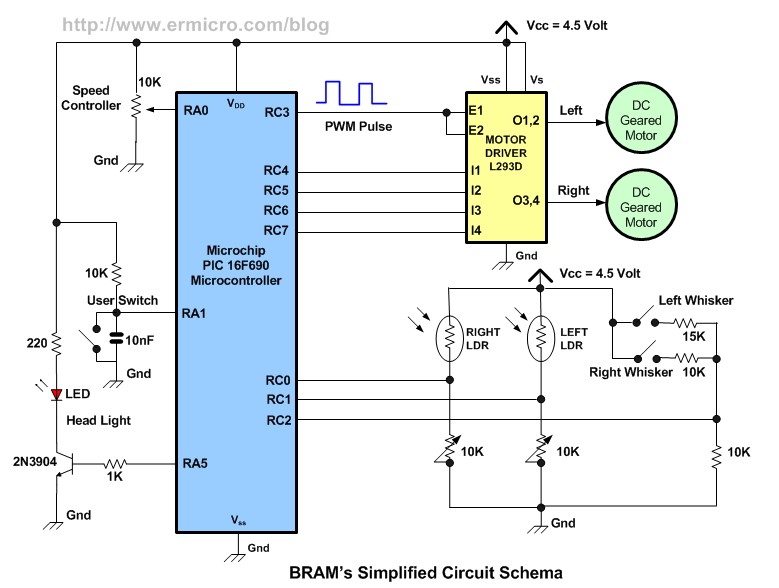
The following are the list of BRAM’s construction material parts:
- Two CD/DVDs for the chassis
- Two geared DC motor rated 4.5 to 5 volt with the wheel or you could use the modified servo motor (it’s a servo motor without the electronics’s control board)
- One 3 x 1.5 volt AA battery holder with on-off switch
- One plastic bead (usually it use for the neck less) and one paper clip for the caster
- Two microswitches and two paper clips for the whisker or bumpers sensor (not shown on the above picture).
- Nuts, bolts, PCB (printed circuit board) holders, double tape to hold all of these parts together.
Demo Video
Friday, July 30, 2010
Versatile Central Heating Program Controller using PIC16F628A
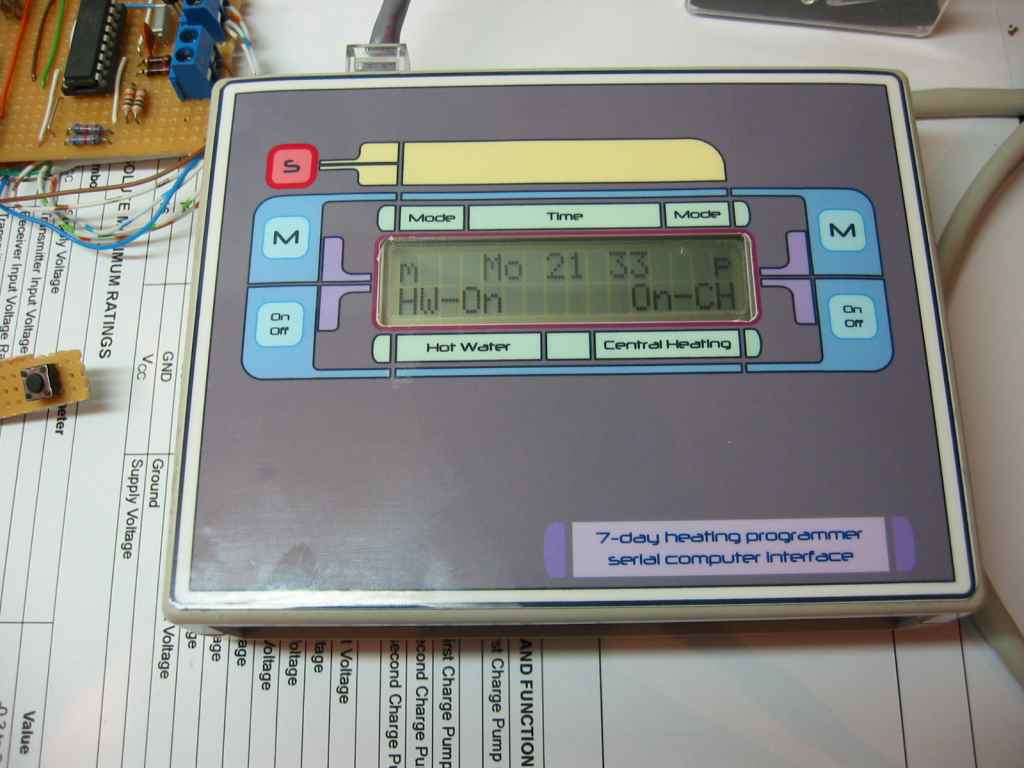
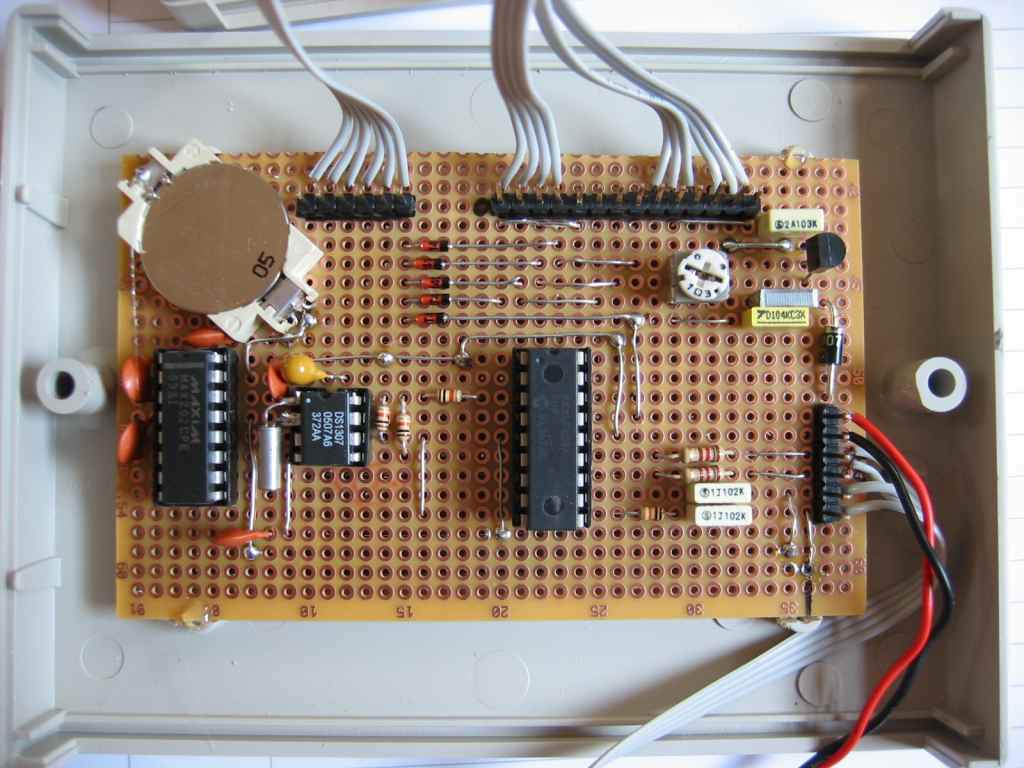
This central heating program controller is designed to use with a heating boiler. The two relays control the supply of hot water and heating. It has a front panel switch control with a 16x2 LCD screen. It also provides a serial interface that allows to be operated remotely from a PC.
The programmer and boiler control relays are contained in separate units so that the relays can be located close to the boiler while the programmer itself can be located anywhere in the house using low voltage connections back to the relay unit. Besides you can also make a serial interface connection local to the programmer in which case you only need 4 wires for power and relay controls. Source: http://picprojects.org.uk/projects/chc/chwkg.jpg
Features
* Independent control for heating and hot water.
* 10 flexible program entries.
* Programs can be set to operate Mon-Fri / Sat-Sun / Mon-Sun.
* Manual advance for water and heating
* Water and heating can be independently set to manual or programmed control.
* Operation and setup from front panel or remote serial CLI
* Battery backup for Real Time Clock (RTC), program settings and manual control.
* Programmer can be located remotely from boiler using low voltage signals over CAT5 or 6-core alarm cable.
* RS232 serial interface with command line interface allows full control and setting from any computer.
* Front panel control can be locked-out from serial CLI
* Based on Microchip PIC 16F628A microcontroller

The programmer and boiler control relays are contained in separate units so that the relays can be located close to the boiler while the programmer itself can be located anywhere in the house using low voltage connections back to the relay unit. Besides you can also make a serial interface connection local to the programmer in which case you only need 4 wires for power and relay controls.
 Source: http://picprojects.org.uk/projects/chc/chwkg.jpg
* Independent control for heating and hot water.
* 10 flexible program entries.
* Programs can be set to operate Mon-Fri / Sat-Sun / Mon-Sun.
* Manual advance for water and heating
* Water and heating can be independently set to manual or programmed control.
* Operation and setup from front panel or remote serial CLI
* Battery backup for Real Time Clock (RTC), program settings and manual control.
* Programmer can be located remotely from boiler using low voltage signals over CAT5 or 6-core alarm cable.
* RS232 serial interface with command line interface allows full control and setting from any computer.
* Front panel control can be locked-out from serial CLI
* Based on Microchip PIC 16F628A microcontroller
Subscribe to:
Posts (Atom)